Map of Consciousness
The Map of Consciousness: A Simple Guide to How Awareness Expands
The Map of Consciousness is a powerful framework introduced by David R. Hawkins, most widely known through his groundbreaking book Power vs. Force. While the book itself can feel technical and dense at times, the core idea behind the Map of Consciousness is surprisingly simple—and deeply practical.
At its essence, the Map of Consciousness explores how human awareness operates energetically, and how our emotional and psychological states directly shape the way we experience life, make decisions, and relate to the world.
A Spectrum of Human Emotion and Awareness
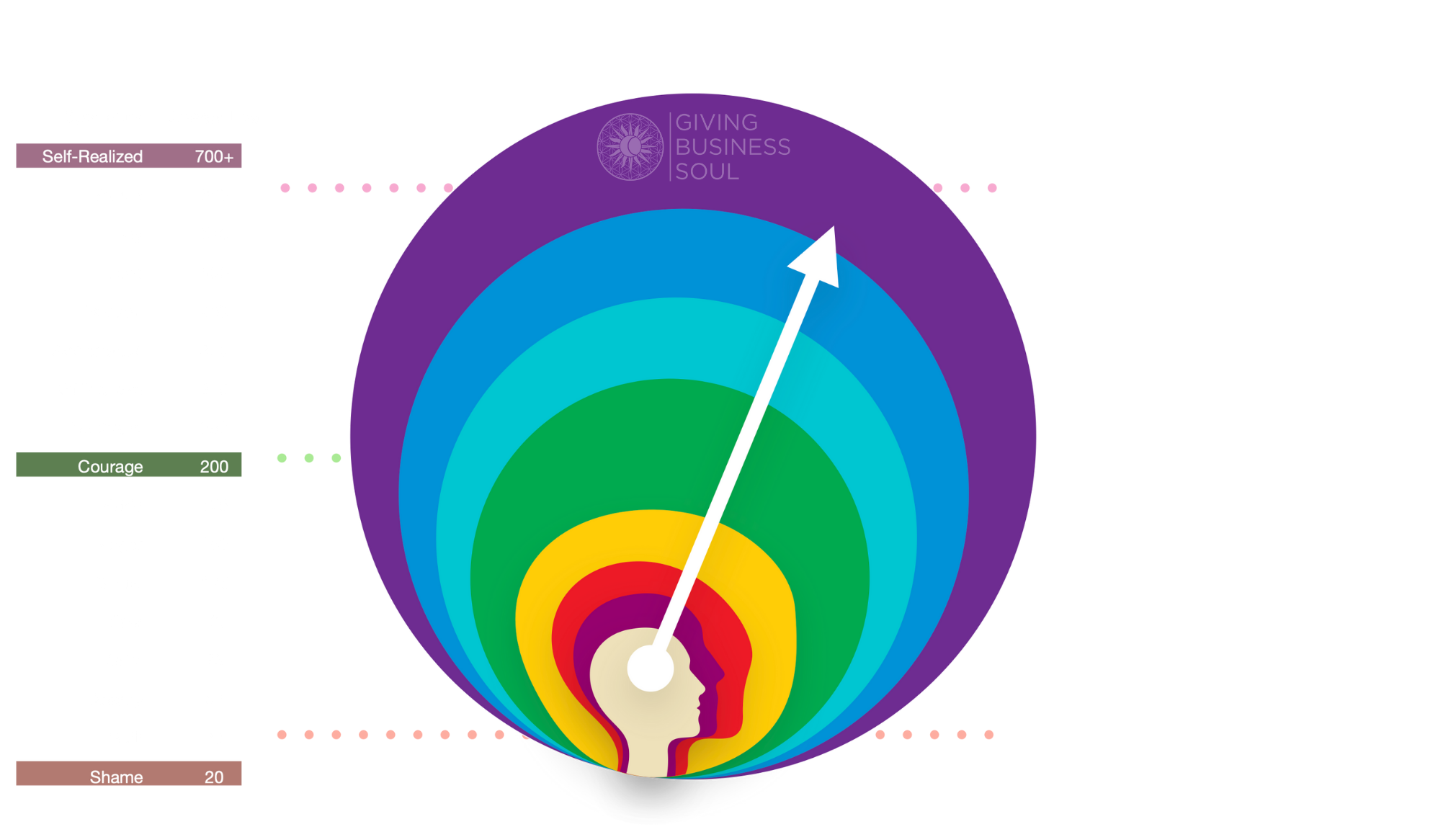
If you look at the map above, you’ll notice a vertical scale on the left-hand side that ranges from what Dr. Hawkins identified as the lowest levels of consciousness—such as shame, guilt, apathy, grief, and fear—to progressively higher states like courage, neutrality, willingness, acceptance, reason, love, joy, peace, and ultimately a self-realized state.
Each of these emotional states is not just a feeling—it represents a level of awareness. According to Dr. Hawkins’ research, these levels were calibrated using applied kinesiology (muscle testing), a method he believed could measure the relative energetic strength or weakness of different states of consciousness. While the methodology itself is debated, the pattern the map reveals has resonated with millions:
Some states of mind contract us, while others expand us.
From Constriction to Expansion
Traditionally, Dr. Hawkins illustrated this concept as a V shape cone—with the narrow base representing constricted awareness (survival, struggle, reactivity) and the widening top representing expanded awareness (clarity, service, flow, and presence).
In our version of the Map of Consciousness, we’ve translated that cone into a circular, expanding visual. This allows us to better represent a three-dimensional, integral view of awareness where consciousness doesn’t just “rise,” but widens.
At the center of the map is the smaller self, the identity formed around fear, protection, and survival. As awareness expands outward, the capacity to experience higher states like neutrality, willingness, acceptance, and love increases naturally.
Color, Consciousness, and Expansion
You’ll also notice the map is color-coded, moving through the spectrum—red, yellow, green, teal, blue, and violet. These colors are meant as helpful visual categories that mirror common models in integral theory and color psychology.
As awareness expands:
Perspective broadens
Emotional resilience increases
Life shifts from reaction to response
Meaning replaces struggle
From Survival to Flow and Service
One of the most practical insights from the Map of Consciousness is the shift from a struggle / survival state to a service / flow state.
Practices such as breathwork, focused work (deep work), physical training, meditation, and intentional self-regulation help move us out of lower reactive states and into higher, more coherent ones. In these states, effort feels lighter, clarity increases, and contribution becomes natural.
This map is not meant to label or judge where someone “is.” Instead, it serves as a reference point—a way to understand:
Why certain emotions feel heavy or draining
Why others feel expansive and energizing
How awareness naturally evolves when supported
A Tool for Awareness
The Map of Consciousness isn’t about permanently living at the “top.” It’s about recognizing the mechanics of awareness, understanding how consciousness contracts and expands, and learning how to move with greater intention.
We share this map simply as a lens—one that helps translate complex inner experiences into something visible, understandable, and actionable.